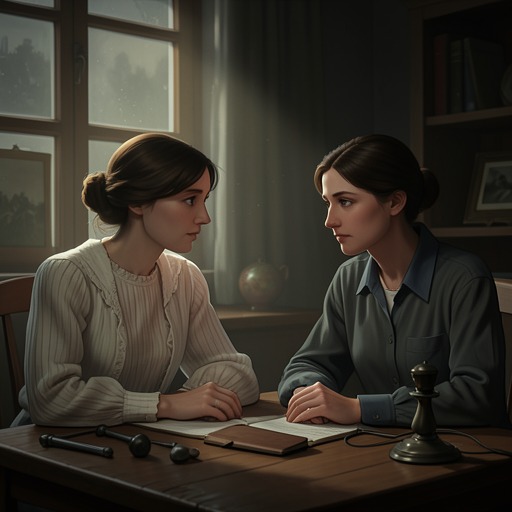
Clarissa Dalloway—Richard Dalloway
Mrs DallowayClarissa Dalloway and Richard Dalloway’s marriage is built less on complete mutual disclosure than on affection, practical support, and an independence each allows the other. Its quiet accommodations provide Clarissa with a counterpoint to the consuming intimacy she rejected with Peter Walsh, while also exposing the limits and conventions of married life.
The Marriage and Its Terms
Clarissa understands her decision not to marry Peter Walsh through the contrast between the two relationships. Living together day after day, she thinks, requires a little licence and independence; Richard gives her that freedom, and she gives it to him. Peter, by contrast, wanted everything shared and examined, a degree of emotional scrutiny she found intolerable. The marriage is therefore not presented as an absence of intimacy but as a form of closeness whose survival depends on preserving private space.
The memory of breaking with Peter remains painful. Clarissa carries the grief as though an arrow were still lodged in her heart, and remembers the shock of hearing at a concert that he had married a woman he met on the boat to India. Peter had called her cold, heartless, and a prude; she could not understand how he cared for her so intensely. His later assurance that he was happy does not erase her sense that his life had failed to become what they once discussed. Against that turbulent history, Richard’s less demanding companionship represents a different, more sustainable arrangement.
Affection in Daily Life
Richard is a practical foundation of Clarissa’s household and emotional world. She connects him with the party’s gay sounds and green lights, with the cook whistling, and with the ordinary life that continues around her. Her sense that she must repay what she receives in daily life extends especially to Richard. The marriage is thus registered not only in declarations but in domestic reciprocity and in the atmosphere of a shared home.
That reciprocity is not a claim that the spouses are always together. On the morning Clarissa goes to buy flowers herself, Richard is away at a committee meeting; she does not even ask which committee. Their separate activity is part of the independence she values, not evidence that the marriage has ceased to matter. The unobtrusive allowance for separate concerns distinguishes their bond from Peter’s demand that everything be brought into common discussion.
Public Identity and Private Distance
The marriage also shapes Clarissa’s place in public life. She has absorbed much of Richard’s public-spirited, governing-class outlook, associated with the British Empire and tariff reform, and recognizes that she often sees things through his eyes. She even feels that she is always quoting him, as if his opinions could be read in the Morning Post. Yet the parties she gives are not simply Richard’s project: they are for him, or for her idea of him, while she herself has the particular ability to make her drawing room a meeting-place.
Clarissa’s role as hostess is therefore both connected to Richard and distinctly her own. She imagines herself as a centre where different lives can meet, a refuge for lonely visitors, and sees bringing people together as her gift. The marriage helps sustain this social world, but it does not subsume her private identity within her husband’s. The difference between what she does for Richard and what she makes of the drawing room keeps the relationship from being reduced to a conventional portrait of a wife serving her husband.
Vulnerability and Care
The marriage’s everyday support becomes especially visible in moments of vulnerability. When Richard is invited to lunch by Lady Bruton without Clarissa, the exclusion shocks her. She insists that no vulgar jealousy will separate her from Richard, yet the moment leaves her shivering and feeling suddenly aged and diminished. Her reaction shows how strongly her sense of belonging is bound to their shared life, even when she knows that her husband’s social engagements need not include her.
After Clarissa’s illness, Richard insists that she sleep undisturbed. The arrangement is a concrete expression of care, but it also leaves her with long periods of solitude, in which she reads late into the night. The marriage offers protection without abolishing isolation: Richard can provide conditions for rest, but he cannot occupy every inward space or remove Clarissa’s awareness of time and mortality.
A Bond Measured by Contrast
Clarissa’s reflections make the marriage’s value clearest through contrast. Peter’s closeness threatened, in her judgment, to destroy them both; Richard’s allowance of independence lets two people live together without having to share everything. Their relation is affectionate but not perfectly transparent, socially joined yet privately spacious. Its strength appears in support, familiar domestic life, and the freedom to remain partly separate—a modest form of connection that Clarissa’s memories of Peter help define.